AI Agents
AI Agents vs. Chatbots: The Operational Differences That Decide Adoption
The difference between an AI agent and a chatbot is operational, not technical. Here are the differences that decide whether customers actually use them.
By PointCaaS Advisory Team5 min read
Every executive we talk to has lived some version of the same story. The company launched a chatbot. The demo was impressive, the press release went out, and within a quarter the thing had quietly become a decoration — a widget customers click past on their way to the phone number. Now the same executives are being pitched AI agents, and the pitch sounds suspiciously familiar. The fair question they ask us is: what is actually different this time?
Our answer is that the difference is real, but it is not where the vendors point. The difference is not the model, the natural-language quality, or the demo. It is operational. A chatbot and an AI agent are different kinds of commitments, and organizations that treat an AI agent like a smarter chatbot get chatbot results with a larger invoice. Whether customers actually use the thing comes down to a handful of operational differences that rarely appear on a feature comparison slide.
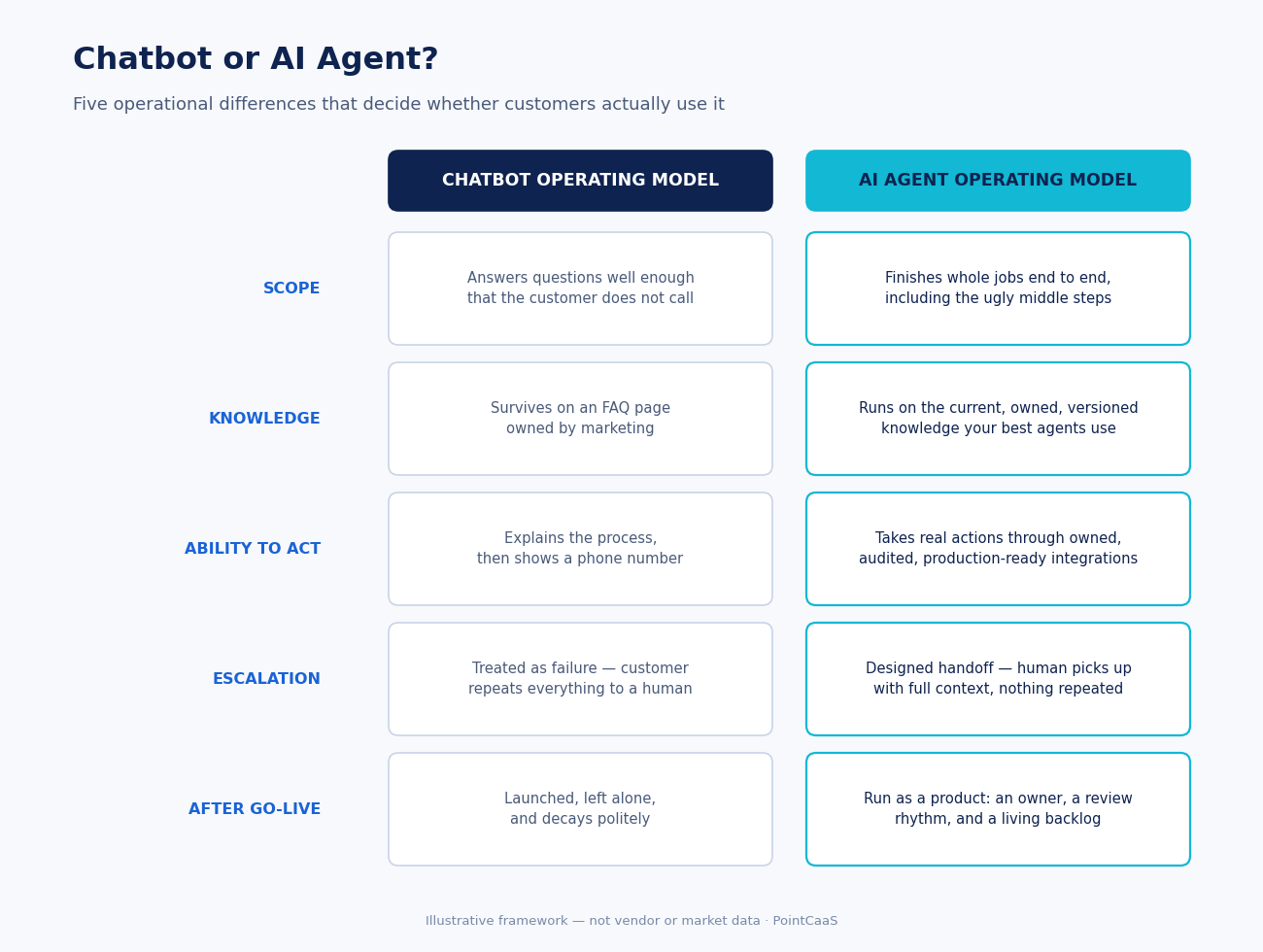
A chatbot answers questions; an AI agent finishes jobs
The chatbot generation was built around deflection. The design goal was to answer a question well enough that the customer would not call. That framing produced a predictable shape: decision trees, FAQ retrieval, and a hard ceiling the moment the customer needed something done rather than something explained.
An AI agent, properly built, is scoped around completion. The customer is not trying to learn about rebooking policy; they are trying to rebook. They do not want to know how address changes work; they want their address changed. When we scope an AI agent engagement, the first artifact is not a list of intents — it is a list of jobs the agent will finish end to end, including the ugly middle steps: authentication, eligibility checks, the write-back into the system of record, the confirmation the customer can trust.
This distinction predicts adoption better than any technology choice. Customers give a self-service channel very few chances. If it finishes the job, they return. If it explains the job and then hands them a phone number, they file it under decoration and never come back. We see this pattern in self-service programs across every industry we work in: usage follows completion, not conversational polish.
The knowledge behind the conversation matters more than the model in front of it
Chatbots failed on knowledge quietly. When a decision tree gave a stale answer, it was wrong in a contained, predictable way. AI agents fail on knowledge loudly, because a fluent system delivering a wrong answer is more convincing than a clunky one. The model will happily narrate outdated policy with perfect grammar.
The operational difference: a chatbot can survive on a marketing-owned FAQ page. An AI agent needs the same knowledge foundation your best human agents use — current, owned, versioned, and reconciled with what the systems of record actually do. In most organizations we walk into, that foundation does not exist yet. The knowledge lives in tribal memory, in outdated intranet pages, and in the heads of tenured agents. Standing up an AI agent on top of that is not an AI project; it is a knowledge project wearing an AI badge, and the sequencing has to respect that.
An agent that cannot act is a chatbot with better manners
The word "agent" implies agency: the ability to take action in real systems. That ability is not a model capability. It is an integration capability, and integration is where AI agent programs go to stall.
Every action the agent takes — issuing a credit, changing a booking, updating an account — requires an API that works, an owner who maintains it, security review, and an audit trail. None of that is glamorous, and all of it is on the critical path. When we assess stalled AI programs, the most common finding is an agent that can converse beautifully about actions it has no ability to perform, because the integration work was deferred to a phase two that never came.
The practical test we give executives: for each job on the agent's list, ask who owns the API it depends on, when it was last exercised in production, and what happens when it fails mid-conversation. If those questions have no answers, the program has a sequencing problem, not an AI problem.
Escalation design is where customers decide whether to trust you
Chatbots treated escalation as failure, and it showed. The customer who typed "agent" five times and re-explained everything to a human learned a durable lesson about that channel.
AI agents make the handoff more important, not less, because the agent handles more of the conversation before any handoff happens. The moment of transfer is the moment the customer judges the whole system. Done well, the human picks up with full context — what the customer wanted, what the agent tried, where it stopped, what is already verified — and the customer never repeats themselves. Done badly, the AI agent becomes an elaborate hold queue.
This is as much an agent-experience question as a customer-experience one. Human agents inherit the conversations the AI could not finish, which means they inherit the hardest work. If the handoff arrives without context, you have made their job worse while telling the board you automated it. Teams that get this right design the handoff as a first-class deliverable — context payload, warm framing, and routing that reflects what the AI already learned — before they expand what the agent handles.
Deployment is a date; adoption is an operating rhythm
The deepest operational difference is what happens after go-live. A chatbot could be launched and left alone, decaying politely. An AI agent is a system that behaves probabilistically, touches production systems, and encounters customer language nobody scripted. It requires an operating rhythm: someone reviewing conversations weekly, someone deciding which failures become fixes, someone retiring guardrails that proved unnecessary and adding ones that proved essential.
In our experience, the organizations whose AI agents customers actually use all run some version of this loop, and the organizations with abandoned agents all skipped it. The technology in both groups is often identical. What differs is that one group treated the agent as a product with an owner and a backlog, and the other treated it as a project with an end date.
Start with the job, not the technology
If you are evaluating this space, the vendor question — which platform, which model — is the third question, not the first. The first is: which customer jobs will this system finish end to end, and do we have the knowledge and integrations to let it? The second is: who owns it after launch, and what rhythm keeps it improving? Answer those and most platform choices become straightforward. Skip them and no platform will save you.
We have built both generations of this technology inside large enterprises, and we have rescued programs that learned these differences the expensive way. If you are weighing an AI agent initiative — or holding a chatbot that customers have stopped using — a working session on the jobs, the knowledge, and the sequencing is the fastest way to find out what you are really signing up for. Talk to Caasy.
More insights
- AI AgentsContact Center AI Readiness: What Has to Be True Before AI Will WorkMost contact center AI programs do not fail because of the model. They fail because the environment around the model was never ready. Here is the readiness test we apply before recommending AI to anyone.
- Amazon ConnectSequencing an Amazon Connect Migration So No Single Step Can Hurt YouMost contact center migrations fail at the cutover, not the build. The fix is sequencing — choosing an order of migration where every phase is small enough to reverse.