Healthcare
The Contact Center Is Healthcare's Real Front Door
Patients meet your health system through a phone call long before a lobby. Designing healthcare's real front door: governance, authentication, safe automation.
By PointCaaS Advisory Team4 min read
Health systems spend enormous energy on the front door patients see — the lobby, the portal, the branding on the building. But for most patients, the first real interaction with a health system is a phone call: to schedule, to ask about a bill, to find out whether a symptom needs a visit. That call, not the lobby, is the front door. And in most systems we look at, it is the least designed part of the entire patient experience.
The gap matters more in healthcare than anywhere else, because the person calling is rarely at their best. They are worried, they are in pain, or they are calling on behalf of someone who is. Every minute of hold time and every repeated question lands on a person who has less patience to spare than any retail customer ever will.
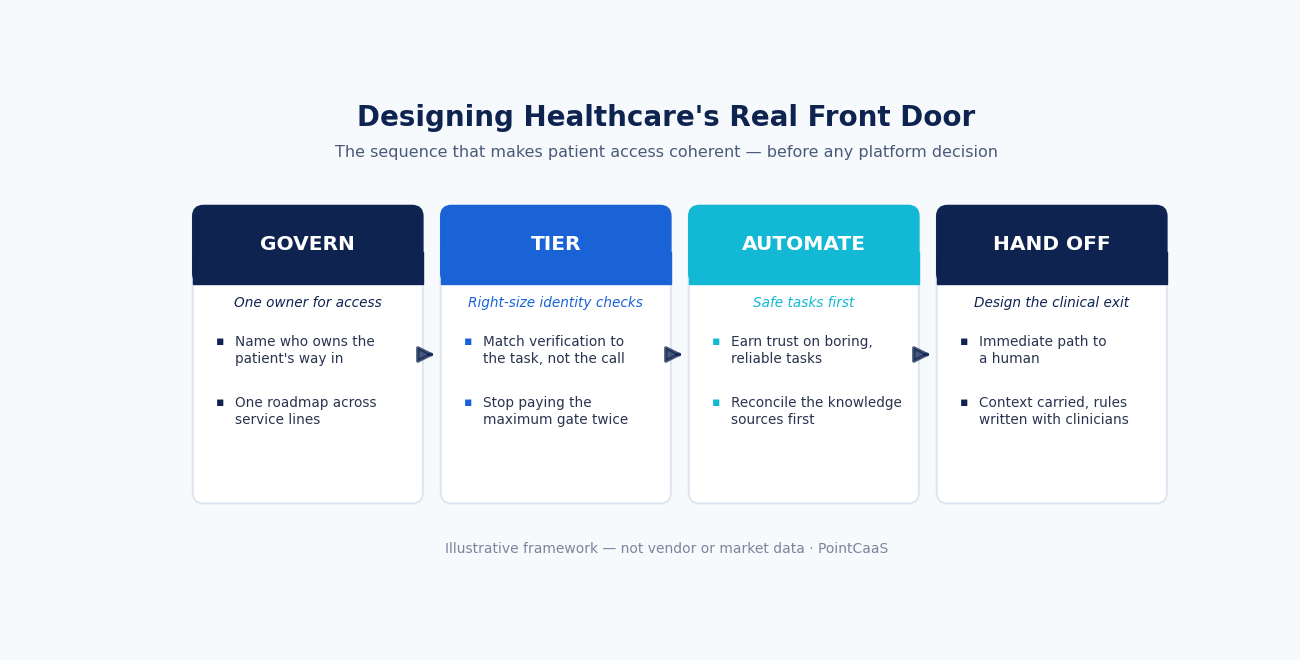
Patients do not experience your health system — they experience your phone tree
Inside the organization, the contact center is usually owned as a cost line under operations or revenue cycle. Outside the organization, it is the health system. The patient does not know that scheduling, billing, and nurse triage are three departments with three phone platforms. They know they called, got transferred twice, and had to spell their name three times.
The operational cause is almost always fragmentation. Access grew up service line by service line, each with its own numbers, its own rules, its own hours. Consolidating that into a coherent front door is less a technology project than a governance one: someone has to be given authority over the patient's experience of getting in, across departments that have never shared a roadmap. In our experience, health systems that skip that governance step and go straight to platform selection end up with a modern platform faithfully reproducing the old fragmentation.
Authentication is where compassion goes to die
Healthcare has a real obligation to verify who is calling before discussing anything clinical or financial. But obligation is not an excuse for interrogation. We regularly walk through patient access flows where a caller must recite the same identifiers to the IVR, then to the first agent, then again after a transfer — each round communicating, unmistakably, that the system was not listening.
Designing authentication for healthcare means deciding, deliberately, which tasks need which level of identity confidence. Confirming that an office is open needs none. Rescheduling an appointment needs some. Discussing results needs the most. When every call is forced through the maximum gate regardless of intent, you pay twice: patients abandon, and agents spend their first minute on ceremony instead of care. Getting this tiering right is usually the single highest-value fix in a healthcare self-service program, and it requires clinical, compliance, and CX leaders in the same room — which is exactly why it rarely happens without someone forcing the meeting.
Self-service earns trust one safe task at a time
The temptation in healthcare AI right now is to aim the technology at the hardest problem first — symptom triage, clinical questions, the conversations with the highest stakes. We would argue for the opposite sequence. Trust between patients and automation is built on boring, reliable tasks: confirming an appointment, checking a referral status, paying a balance, requesting a refill through the proper channel. Each completed task teaches the patient that the automated front door works. Each failure teaches them to zero-out immediately, forever.
The knowledge foundation matters more than the model. An AI agent is only as safe as the sources it draws from, and health systems are full of contradictory documents: the website says one preparation protocol, the clinic's printed sheet says another. Before any conversational AI takes a patient-facing task, someone has to own reconciling that content — and keep owning it after go-live, because clinical guidance changes.
The clinical handoff is a design object, not an escalation
Every automated healthcare conversation needs a designed exit to a human, and the design bar is higher here than in any other industry. A retail bot that fails gracefully loses a sale. A healthcare bot that buries the path to a nurse can cause genuine harm — and the fear of that outcome is precisely why clinicians distrust automation.
The answer is not to avoid automation; it is to make the handoff a first-class deliverable. The receiving nurse or agent should see what the patient already said. The transition should be immediate for anything that smells clinical. And the escalation rules should be written with clinicians, so the people who carry the license trust the system that routes to them. When we review stalled healthcare AI programs, a handoff nobody designed — and therefore nobody trusts — is the most common reason the pilot never left the pilot.
Access is a promise the whole system makes
The health systems getting this right treat patient access as a product with an owner, a roadmap, and a feedback loop from the people answering the calls — not as a queue to be staffed. They sequence automation from safe tasks toward harder ones, they design the human handoff before the bot, and they measure success by whether patients got what they needed, not by how many calls were kept away from staff.
If your patient access numbers look fine on the dashboard but your patients and schedulers tell a different story, that gap is worth examining with people who have rebuilt front doors before. Talk to Caasy — we will help you find where the front door is actually stuck.
More insights
- AI AgentsContact Center AI Readiness: What Has to Be True Before AI Will WorkMost contact center AI programs do not fail because of the model. They fail because the environment around the model was never ready. Here is the readiness test we apply before recommending AI to anyone.
- Amazon ConnectSequencing an Amazon Connect Migration So No Single Step Can Hurt YouMost contact center migrations fail at the cutover, not the build. The fix is sequencing — choosing an order of migration where every phase is small enough to reverse.