Strategy
The Questions to Ask Before You Sign Any CCaaS Contract
An operator’s guide to CCaaS vendor evaluation: exit terms, usage-based pricing traps, implementation ownership, and the questions demos are designed to avoid.
By PointCaaS Advisory Team4 min read
The demo answers questions nobody asked
Every CCaaS platform demos beautifully. The routing is elegant, the dashboards are crisp, the AI assistant summarizes a call in front of your eyes. That is not an accident — the demo is the most rehearsed artifact the vendor owns, and it is built to answer the questions that make buying feel safe.
The questions that decide whether you are happy in year two are different ones, and almost none of them appear on a demo agenda. We have sat on both sides of these evaluations — running them inside Fortune 500 contact centers and untangling them afterward — and the pattern is consistent: the pain that shows up after signature was almost always visible before signature, in the contract, if anyone had asked.
Here are the questions we would not sign without answering.
Ask what leaving costs before you ask what joining costs
The joining price is on the proposal. The leaving price never is, and it is the number that actually determines your negotiating position for the life of the relationship.
Before signature, you want plain answers to: how do we export our data — call recordings, transcripts, contact history, reporting — and in what format? What happens to integrations we build on your proprietary tools if we migrate away? What are the early-termination mechanics, and do committed volumes carry forward if our business shrinks?
A vendor who answers these clearly is telling you they expect to earn renewal on merit. A vendor who deflects is telling you something too.
Usage assumptions are where the money hides
CCaaS pricing looks simple — per agent, per minute, per interaction — and each of those units hides an assumption. Concurrent versus named agents changes the bill for any operation with part-time staff or seasonal peaks. Minute-based pricing behaves differently for a business whose calls are long and complex than for one doing quick transactions. Consumption-based AI features can turn a successful self-service rollout into an invoice surprise: the better the bot does, the more you pay.
The exercise that protects you takes an afternoon: model your own worst month, best month, and a growth case against the actual rate card, not the blended number on the summary slide. Ask the vendor to walk through the model with you. Where they hesitate is where you should read the fine print twice.
"Included" and "available" are different words
Feature lists blur two very different things: what your subscription includes, and what exists somewhere in the catalog. Workforce management, quality monitoring, advanced analytics, higher-tier support, sandbox environments — each is commonly a separate line item, and the gap between the demo environment (everything switched on) and your contracted tier can be wide.
The discipline here is simple: for every capability that influenced your decision, find the line in the order form that names it. If you cannot find the line, it is not in the deal.
Who does the work — and whose payroll are they on
Platforms do not migrate themselves. Somebody rebuilds your routing, your integrations, your reporting, and trains your teams — and the contract should say who. If implementation is a partner, which partner, with what accountability back to the vendor when things slip? If it is the vendor's professional services, what is scoped in hours versus outcomes? And after go-live: what does support actually cover at your tier, with what response commitments, and what falls to your own administrators?
The operating question behind platform selection — who runs this thing on day 400, and are they set up to succeed — is worth more diligence than any feature comparison. Platforms rarely fail on capability. They fail on ownership.
The roadmap is not a commitment
Every evaluation includes a moment where a missing capability is answered with "that's on the roadmap." Sometimes it is true. But a roadmap slide is a statement of intent, not an obligation, and contracts are the place where intent goes to be tested.
If a future capability is material to your decision, ask for it in writing with a date and a remedy. If the vendor won't put it in the contract, make your decision as if the capability does not exist — because contractually, it doesn't.
The one-page version
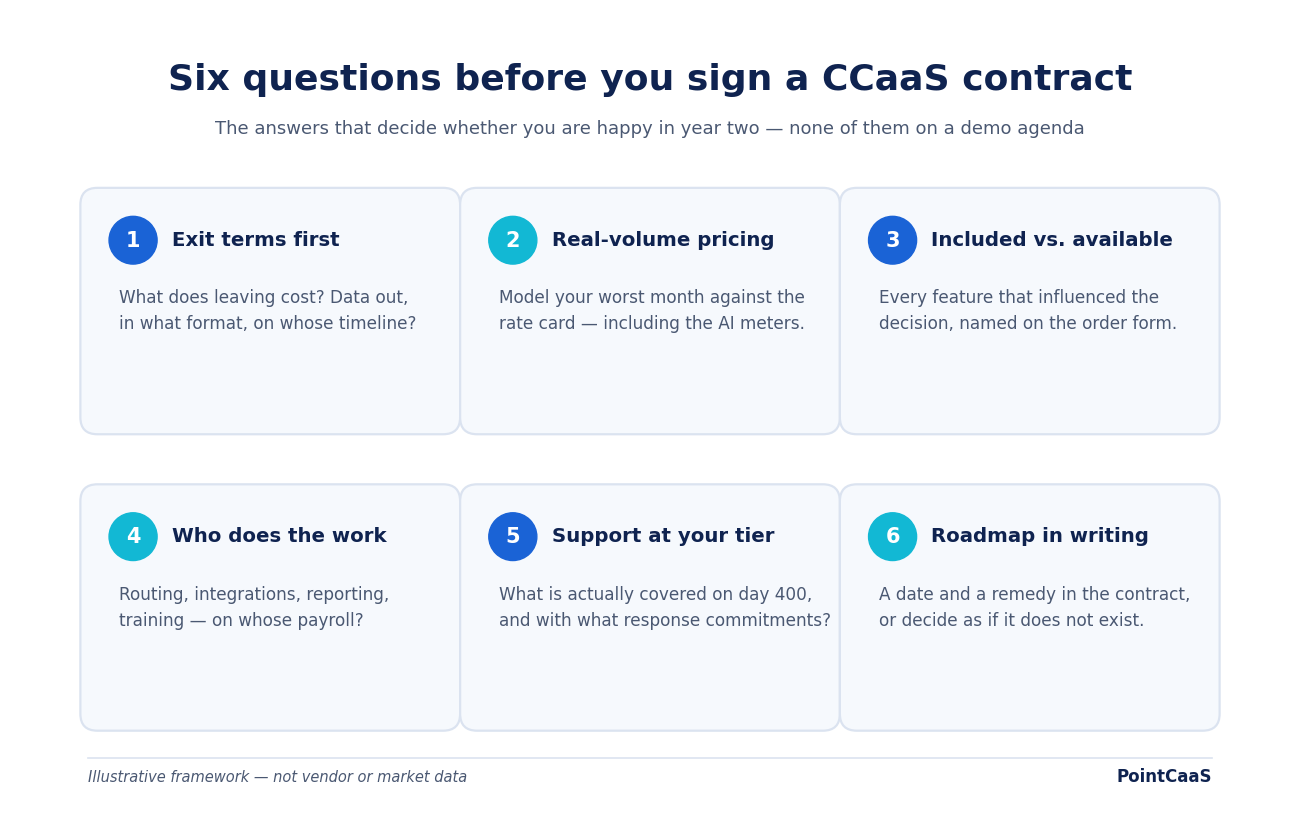
If we had to compress the diligence into a single page taped to the negotiating room wall, it would read: exit terms and data portability, in writing. Pricing modeled on your real volumes, including the AI meters. Every decision-influencing feature named on the order form. Implementation ownership with named accountability. Support tier verified against your operation's reality. Roadmap promises contracted or ignored.
None of this is adversarial. The best vendor relationships we have seen were the ones where these questions got straight answers early — both sides knew exactly what they were agreeing to, and the energy went into the work instead of the disputes.
Bring the contract, not the brochure
We help leaders run CCaaS evaluations and negotiate from an operator's view of where these agreements bite — including when the answer is that your current platform, run properly, is the better deal. If you are inside an evaluation now, or holding a proposal that looks a little too clean, bring us the hard questions before you sign. Start the conversation at Talk to Caasy — the first human you speak with will be someone who has sat through these negotiations from your side of the table.
More insights
- AI AgentsContact Center AI Readiness: What Has to Be True Before AI Will WorkMost contact center AI programs do not fail because of the model. They fail because the environment around the model was never ready. Here is the readiness test we apply before recommending AI to anyone.
- Amazon ConnectSequencing an Amazon Connect Migration So No Single Step Can Hurt YouMost contact center migrations fail at the cutover, not the build. The fix is sequencing — choosing an order of migration where every phase is small enough to reverse.